
- 06/05/2026
- Posted by: Janick Pettit
- Categories: Articles, Retail, SagaBrand, South Africa, Supermarkets
Last updated on 24/06/2026
South Africa’s supermarket sector is one of the most competitive retail landscapes on the continent. According to Statistics South Africa — Retail Trade Sales, December 2025, retail trade sales grew by 3.7% in 2025 (vs. 2024). The top supermarkets in South Africa are competing hard to capture every rand of that growth. In a market where consumers interact with 15 or more brands, the question for retailers and FMCG brands is no longer who has the highest awareness. It is who earns genuine preference, and why.
To answer that question, we used SagaBrand, our pan-African brand health tracker, to measure 15 grocery and general merchandise retailers across the full purchase funnel, from awareness to recommendation, alongside key brand image attributes spanning price, experience, service, product, and relationship dimensions. To note that health and beauty chains such as Clicks and Dischem fall outside the scope of this wave.
Here is what the data reveals about supermarket brand health in South Africa and what it tells retailers and FMCG brands operating in this market.
South Africa’s retail market: intense competition, informed shoppers
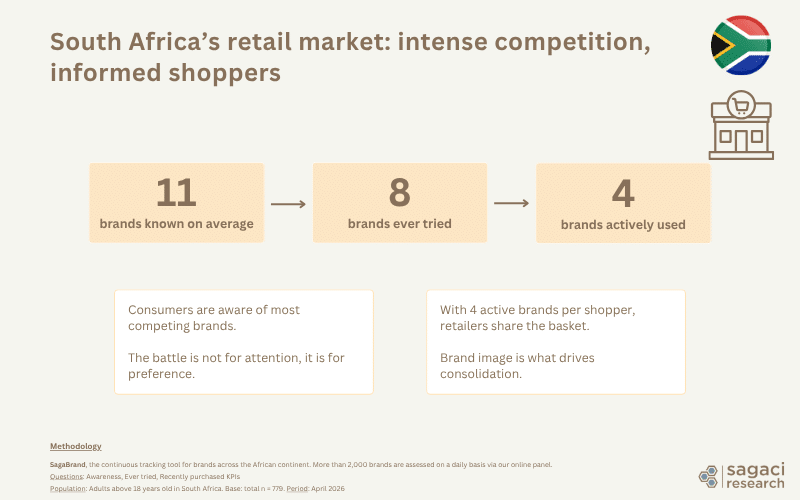
Behind that growth lies a demanding consumer: on average, they are aware of 11 supermarkets, have tried around 8, and actively use 4 on an ongoing basis. This is not a market where any retailer benefits from a low-awareness playing field. Every brand is competing for share of an already well-mapped consideration set.
How South Africa’s top supermarkets compete: preference, brand image, and strategic positioning
So which retailers do South African consumers actually prefer? Based on SagaBrand data collected in April 2026, here is how the top supermarkets in South Africa rank:
-
- Checkers
- Shoprite
- Woolworths
- Pick n Pay
- Spar
- Food Lovers Market
- Boxer
- Walmart
- Rhino Cash & Carry
- Kit Kat Cash & Carry
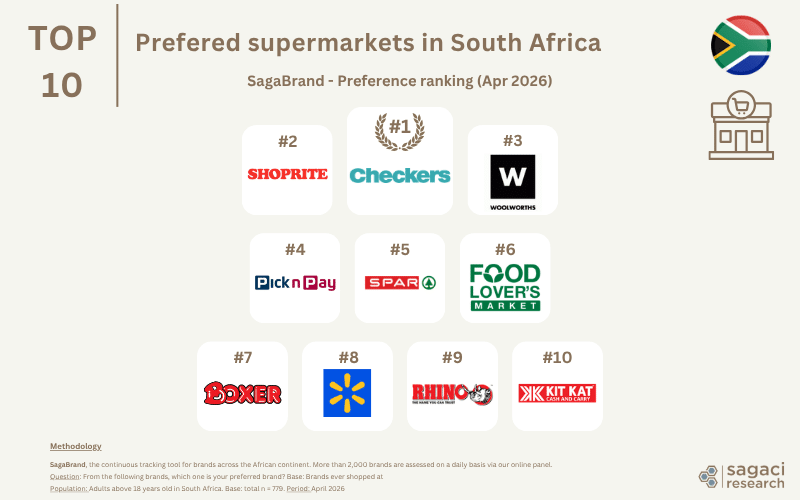
Checkers, Shoprite, and Woolworths lead on preference, but Pick n Pay sits firmly among the top four on most other brand health indicators, including awareness, reach, and ever-purchased rates. Together, these four brands define the competitive core of South Africa’s supermarket landscape. Their headline preference metrics are broadly similar across the top three: awareness above 84%, ever-purchased rates above 74%, and consideration above 62%. But the reasons consumers prefer each of them are distinct, and that distinction carries real strategic weight.
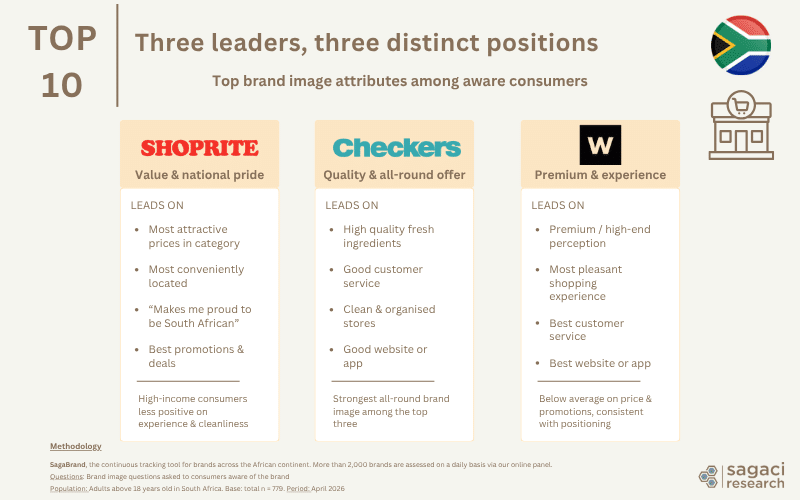
Shoprite: value and national pride
Shoprite is the price and convenience leader. It scores highest in the category on attractive prices (67%), promotions and deals (66%), and convenient store locations (74%). It also leads on “makes me proud to be South African” (64%), a relationship attribute with genuine emotional resonance. Among lower-income consumer segments, these perceptions are even stronger. The counterpoint: higher-income consumers are measurably less positive about Shoprite’s store cleanliness, shopping experience, and customer service, suggesting the brand carries a different meaning across socioeconomic groups.
Woolworths: premium positioning and experience
Woolworths occupies a different position entirely. It leads the category on premium perception (80%), high-quality fresh ingredients (69%), pleasant shopping experience (68%), customer service (71%), and website or app quality (51%). These are not close results: they are category-defining gaps. The trade-off is that Woolworths scores below the category average on price attractiveness and promotions, which is entirely consistent with a premium positioning. Its user base skews toward 36+, high-income, and upper socioeconomic consumers, reflecting a profile that is coherent and intentional.
Checkers: the all-round challenger
Checkers performs strongly across brand image attributes that sit between Shoprite’s value positioning and Woolworths’ premium offer. It scores well on fresh ingredient quality, customer service, website and app experience, and clean and organised stores. With the most preferred brand title and a consistently strong image across consumer segments, Checkers appears to have found a sweet spot: accessible enough for the mainstream, credible enough on quality to attract more demanding shoppers.
Pick n Pay: strong fundamentals
Pick n Pay sits firmly among the top four on most brand health indicators, with awareness, reach, and ever-purchased scores broadly in line with Shoprite and Checkers, making it also a major force in the market by any broad measure.
The brand is also mid-turnaround: CEO Sean Summers has acknowledged the competitive pressure from rivals and is focused on building a quality operation that can sustain profitability over the long term, with significant investment directed at upgrading stores and improving the in-store experience. Our data suggests the direction is right: experience and service are exactly where Pick n Pay has room to close the gap with competitors.
Customer satisfaction: a different lens on South Africa’s supermarket rankings
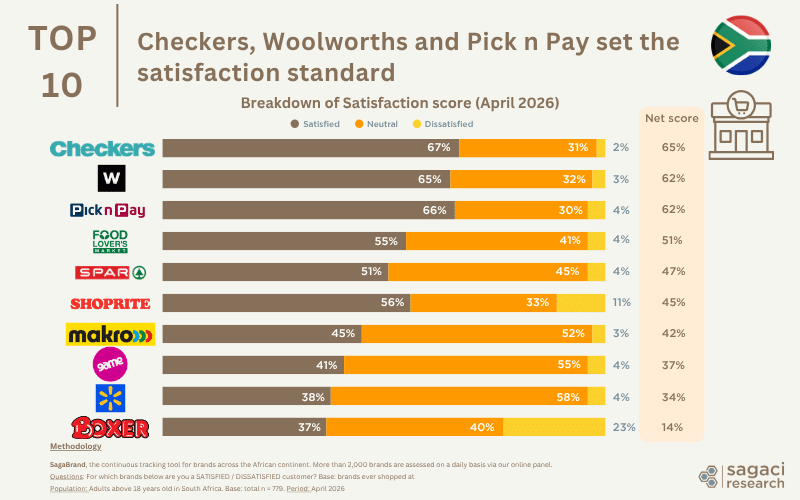
Checkers, Woolworths, and Pick n Pay set the satisfaction standard. All three lead the category with net satisfaction scores above 60%.
The gap to the rest of the field is notable: Food Lovers Market and Spar hold a solid mid-tier, while Shoprite, despite leading on preference, ranks sixth on satisfaction with a net score of 45%. High dissatisfaction among higher-income shoppers pulls the score down, even as lower-income consumers rate the brand highly. Being the most preferred supermarket in South Africa and being the most satisfying are not the same thing.
The awareness trap: supermarket brands South Africa knows but does not choose
Spar, Boxer, and Makro each carry solid awareness scores: 88%, 86%, and 80%, respectively. But preference drops sharply, to 12%, 8%, and 3%. Satisfaction and recommendation scores follow a similar pattern, sitting below the levels achieved by the top three.
For these brands, the strategic challenge is not Reach. It is conversion and experience. A few factors help explain the gap:
-
- Spar’s franchise model may partly explain its inconsistency: store quality, pricing, and experience can vary significantly across outlets, making it harder to build a coherent brand image at scale.
- Makro’s low preference and satisfaction scores reflect a format issue as much as a brand issue: as a wholesale and bulk retailer, it is not primarily targeting everyday grocery shoppers, which naturally limits its performance on consumer brand metrics.
- Boxer carries the highest dissatisfaction rate in the category (23%), pointing to a brand experience problem that goes beyond positioning or format.
Understanding the grocery retail formats that South African consumers are gravitating toward adds further context to why some brands convert better than others in this market.
What the data tells us about supermarket brand health in South Africa
The brands performing best on preference are not simply the largest by store count. They are the ones that own a distinct place in the consumer’s mind: Shoprite on value and national pride, Woolworths on quality and experience, Checkers on a strong all-round offer. The brands that underperform on preference relative to their awareness tend to lack that clarity.
Brand image is not a soft metric in this market. It drives consideration, preference, and repeat purchase. And in a category where consumers are already aware of 11 brands on average, the battle is rarely for attention. It is for meaning.
We have explored similar dynamics across Africa, from Côte d’Ivoire to Morocco, where brand perception gaps between leading and mid-tier retailers also prove decisive.
For South Africa, this is the freshest picture available, drawn from data collected in April 2026. Download our summary slides for a snapshot of the key findings on the top supermarkets in South Africa, or get in touch for deeper insights.
Data and methodology
SagaBrand is Sagaci Research’s continuous brand health tracking tool in Africa, measuring brands across the continent. Data is collected daily via our online panel in Africa.
KPIs tracked include awareness, echo, reach, quality score, ever purchased, recently purchased, preference, satisfaction, recommendation, consideration, and likelihood to purchase.
Brand image is assessed across 15 attributes covering price, experience, service, product, and relationship dimensions.
Population: adults aged 18 and above, members of our online panel in South Africa.
Period: April 2026.
Total base size: 779
© Images by Magnific