
- 10/08/2026
- Posted by: Janick Pettit
- Categories: Articles, SagaProduct, Senegal
We asked four AI models a simple question: what are the top carbonated soft drink brands in Senegal? Then we checked the answer against live shopper data, testing AI market data accuracy in Africa against what’s actually on shelves. One real, active brand never showed up in a single AI response.
The question
“What are the top carbonated soft drink brands in Senegal?” is the kind of question a brand, retailer, or agency might genuinely need answered, ahead of a market entry decision, a distribution deal, or a competitive review. It’s also exactly the kind of question people increasingly put straight to an AI model instead of a research provider.
We put it to Gemini, ChatGPT, Perplexity, and Claude.
What AI models said
Coca-Cola, Sprite, Fanta, Vimto, and La Gazelle all appeared across the four models’ answers, in varying combinations. No single model gave the same list. That’s expected: different models, different training data, different retrieval behaviour.
What’s more notable is what none of them said.
The AI blind spot
We compared the AI answers against SagaProduct, our shopper panel in Africa, which tracks real barcode scans from consumers across the carbonated soft drinks market in Senegal:
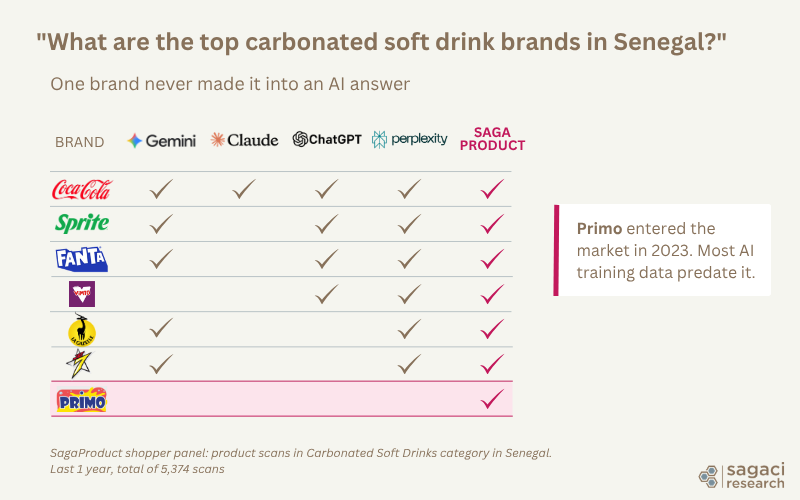
Primo entered the Senegal carbonated soft drinks category in 2023. It shows up in Sagaci’s top 20 FMCG brands in Senegal coverage from 2024 based on SagaProduct shopper data. It also appears consistently in SagaTracker retail audits since late 2023. Two independent sources, two different methodologies, three years of presence. What is missing isn’t market evidence, it’s an online footprint: no press coverage, nothing for an AI model to index.
Why AI market data accuracy breaks down in Africa
There are different reasons AI can get a market question wrong. Sometimes it is working from data that is outdated or stripped of context: Gemini and Claude both cited Coca-Cola at 60% market share for carbonated soft drinks in Senegal, tracing back to a 2022 Sagaci Research article comparing Coca-Cola and Pepsi preference. That study asked which of two brands people preferred, not the actual market share across the full category, but four years later, the number got carried forward and applied to a question it was never designed to answer.
Other times, like with Primo, it is not a misapplied figure. It is not working from anything at all: the brand simply does not exist in whatever is indexed online.
A brand can be real, active, and independently documented in market data and still be invisible to AI, if it never generated enough indexed content to be found.
Market presence and online footprint are two different things. AI can only answer from the second one.
A live shopper panel is not limited that way. SagaProduct tracks what is physically bought, brand by brand, SKU by SKU, across Africa, independent of whether they have an online presence. That is why a brand like Primo shows up in the data regardless of its online footprint.
What this means for brands in Africa
If your team is using AI models to scope a category, map competitors, or validate a market entry decision in Africa, the risk isn’t that the answer is wrong in an obvious way. It’s that it’s confidently incomplete, and the missing piece is often the most commercially relevant one: the newer competitor, the fast-growing local brand, the one nobody’s written about yet.
Live data closes that gap. Click below to request live data on your category to see what is actually in African consumers’ hands, not just what AI has already indexed about them.