

- 15/06/2026
- Posted by: Janick Pettit
- Categories: Articles, Carbonated Soft Drinks, Non-alcoholic beverages, SagaCube

Last updated on 23/07/2026
Carbonated soft drinks consumption in Africa may not top the beverage rankings, but CSDs remain one of the most contested and visible categories on shelf, with clear, actionable patterns in who drinks them, when, and why.
This article draws on data collected through SagaCube, Sagaci Research’s platform tracking consumer data in Africa, covering responses from over 548,000 panel members across all 54 African countries. The survey captures daily drinking habits, occasions, and goes a level deeper to uncover the need states behind those choices.
Carbonated soft drinks: the 6th most consumed beverage in Africa
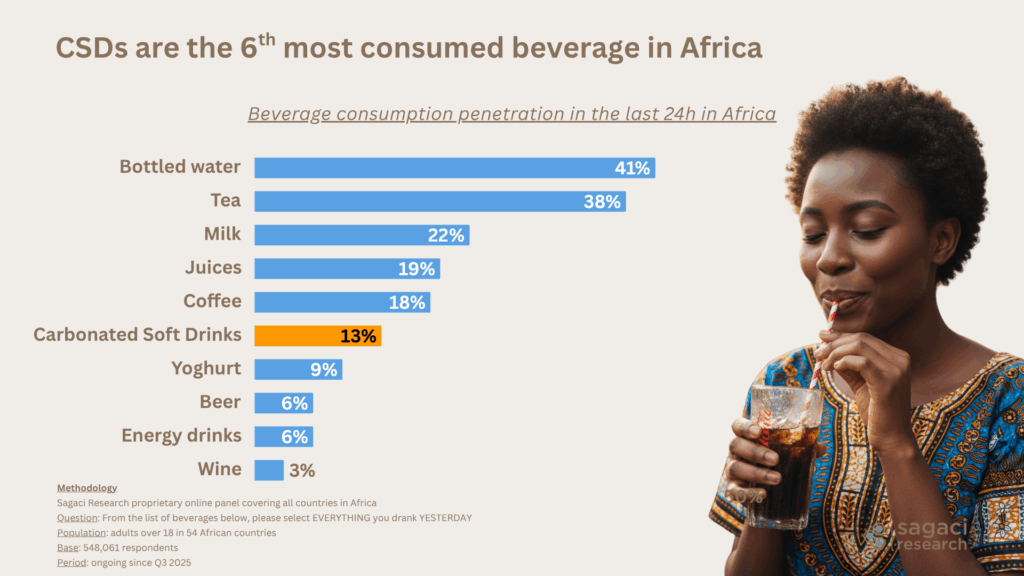
Across all beverages tracked, carbonated soft drinks consumption in Africa sits at 13% of adults on any given day, placing CSDs 6th overall. They sit behind bottled water (41%), tea (38%), milk (22%), juices (19%), and coffee (18%), and ahead of yoghurt (9%), beer and energy drinks (6% each), and wine (3%).
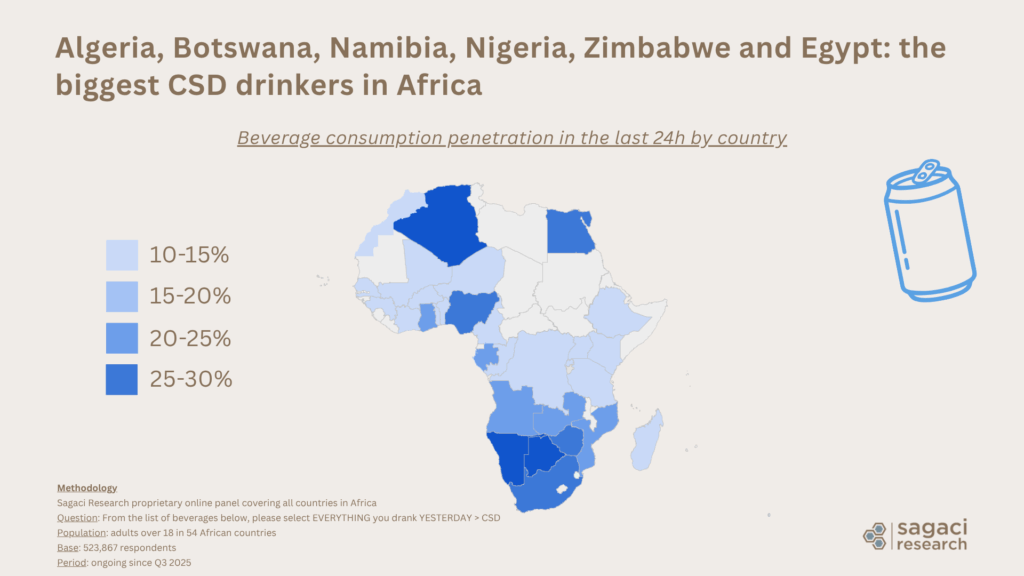
Consumption varies considerably across the continent. Algeria, Botswana, Namibia, Nigeria, Zimbabwe, Egypt, and South Africa stand out with the highest penetration, above 20% of adults on any given day.
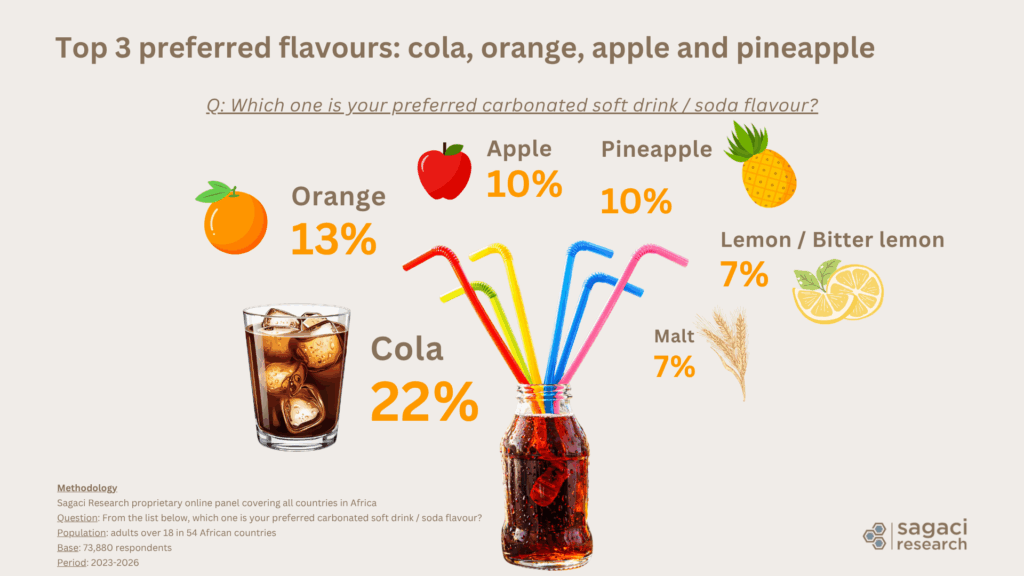
Cola leads flavour preference, while regular sodas still dominate over diet sodas
When it comes to flavour, cola remains the clear favourite at 22%, well ahead of orange (13%), apple (10%), and pineapple (10%). Lemon / bitter lemon and malt flavours follow at 7% each.
On the sugar question, the picture is equally clear. More than half of consumers (53%) say they prefer regular sodas, against 30% who lean towards low sugar, sugar-free, zero, or diet alternatives, and 17% with no strong preference. For brands navigating sugar reduction policies across African markets, regular sodas remain the default for the majority, so taste parity, not diet positioning alone, will be key to shifting habits at scale.
Plastic bottles confirmed as the leading CSD packaging format in Africa
Packaging preferences reveal a gap between what consumers say and what they actually buy. While 42% of consumers declare a preference for plastic bottles, SagaProduct shopper scans show plastic bottles actually account for 65% of purchases, well above stated preference. For most African consumers, plastic bottles remain the practical default, driven by price, availability, and the ability to reseal and share.
CSD consumption occasions in Africa: when, where and with whom
Understanding the occasion structure of CSD consumption in Africa helps brands make smarter decisions on packaging, distribution, and communication.
When do African consumers drink CSDs?
CSD consumption peaks in the afternoon (2pm to 5pm), accounting for 37% of occasions, followed by mid-day (11am to 2pm) at 27%, and early evening (5pm to 8pm) at 21%, in line with mealtimes: 43% of CSD occasions involve eating a meal, more often lunch or dinner.
Where do African consumers drink CSDs?
The home is by far the leading consumption location, accounting for 57% of occasions, with 32% specifically in the living or dining room, pointing to CSDs as a household staple rather than an on-the-go impulse purchase, even if the small plastic bottle remains the format people actually buy most.
Who do African consumers drink CSDs with?
More than a third of CSD occasions (35%) happen alone, while 17% are shared with friends and 16% with family, a solo-leaning, at-home, mealtime profile, though social occasions remain meaningful for brands targeting gatherings and celebrations.
What drives CSD consumption in Africa: the need states
When asked directly why they choose CSDs over other non-alcoholic drinks, taste comes out on top (24%), closely followed by refreshment on a hot day (23%), energy (19%), availability in shops (16%), and affordability (15%).
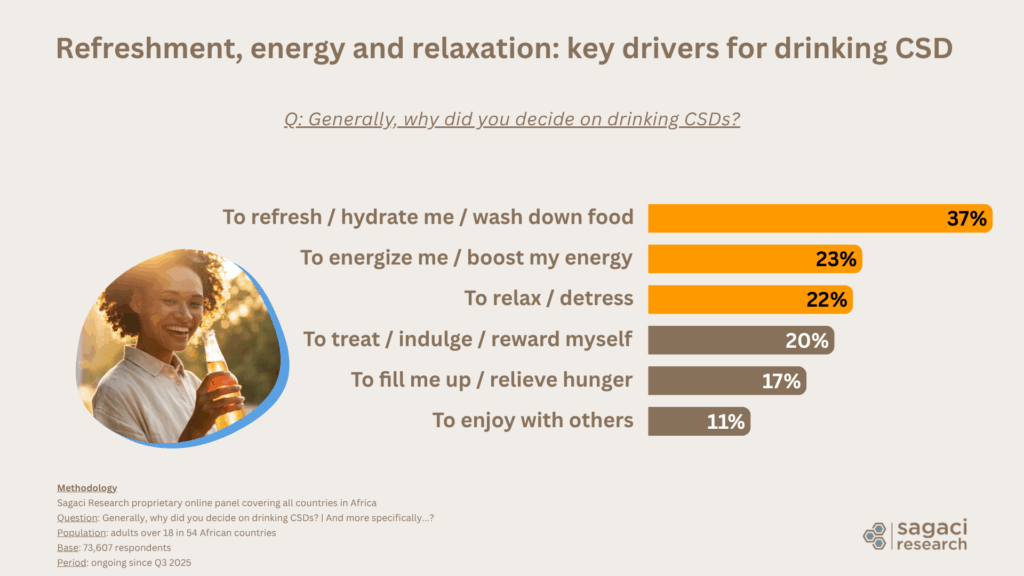
Going a level deeper into the need states behind CSD consumption confirms refreshment as the clear leading driver, with energy, relaxation, and indulgence as meaningful secondary territories.
Driver #1: Refreshing
More than a third of consumers (37%) say their main reason for drinking a CSD is to refresh, hydrate, or wash down food. Within this, the cooling effect (13%) is the leading specific motivation, ahead of quenching thirst (12%) and avoiding dehydration (8%), positioning CSDs as a functional refreshment choice tied to climate and mealtimes.
Driver #2: Energizing
Nearly a quarter of consumers (23%) cite energy as their main motivation: an energy boost or ‘pick me up’ (12%), sustained, long-lasting energy (6%), and getting going for the day (6%). This overlaps with one of the core territories for energy drinks, suggesting CSDs compete for the same ‘I need a lift’ occasions, particularly where energy drinks are less affordable or available.
Driver #3: Relaxing
For 22% of consumers, CSDs are primarily about relaxation or de-stressing: calming down or relieving pressure and stress (10%), clearing the mind (4%), and restoring balance (4%). As with energy drinks, this need state points to the small pause or ritual a CSD break can represent on a busy day.
Driver #4: Indulging
One in five consumers (20%) drink CSDs primarily to treat, indulge, or reward themselves: indulging or rewarding oneself (11%), satisfying cravings (7%), and entertaining the taste buds (7%). This indulgence territory is where flavour innovation, limited editions, and premium formats are likely to resonate most.
Two further needs states round out the picture: filling up or relieving hunger (17%) and enjoying CSDs with others (11%), reinforcing CSDs’ dual role as a snack-adjacent and, to a lesser extent, social drink.
Unlocking growth in the African CSD market with consumer insights
CSD consumption in Africa is concentrated around mealtimes, the home, and individual consumption, driven above all by the need for refreshment, with energy, relaxation, and indulgence as meaningful secondary territories. This points to portfolios and communication anchored on that core driver, with the other three offering room for targeted flavour or format innovation.
On packaging, the gap between declared and actual choices confirms that affordable, resealable plastic bottles should remain the priority for distribution and availability. On sugar reduction, the continued dominance of regular sodas over diet alternatives (53% vs 30%) shows that taste-led reformulation, rather than diet positioning alone, will be needed to shift consumption habits at scale.
For a full picture of the category:
- SagaCube tracks consumption patterns and need states in real time across 54 markets,
- SagaBrand measures brand health across the CSD competitive set,
- SagaProduct delivers SKU-level data on formats and pricing. Together, they give brands the consumer intelligence needed to compete in one of Africa’s most established and most contested beverage categories.
For Need States exploration of related categories, see our analysis of energy drinks consumption in Africa, juice consumption in Africa, and coffee consumption in Africa.
To explore the full insights, download the report below.
Methodology
Carbonated soft drinks consumption in Africa and need states survey leveraging Sagaci Research’s proprietary online panel in Africa, covering all countries on the continent, with the SagaCube consumption tracker.
Questions:
- From the list of beverages below, please select everything you drank yesterday.
- From the list below, which one is your preferred carbonated soft drink/soda flavour?
- When drinking carbonated soft drinks/sodas, which do you prefer?
- What is your preferred packaging type when buying soft drinks?
- What day of the week were you drinking CSDs? What time of day did you have CSDs? Where were you when you had CSDs? Who were you with when you were drinking CSDs?
- Why do you choose to drink carbonated soft drinks instead of other non-alcoholic drinks?
- Generally, why did you decide on drinking CSDs? And more specifically…?
Population: Adults over 18 in 54 African countries
Base: Beverage penetration: 548,061 respondents
Period: Q3 2025 to Q1 2026