

- 22/04/2026
- Posted by: Janick Pettit
- Categories: Articles, Non-alcoholic beverages, SagaCube

Last updated on 23/07/2026
Coffee consumption in Africa ranks fifth among all beverages consumed on any given day across the continent. Understanding who drinks it, when, and why is increasingly relevant for brands operating in the African beverage market.This article draws on data collected through SagaCube, Sagaci Research’s platform tracking consumer data in Africa. It covers responses from over 613,000 panel members across all 54 African countries. Beyond daily drinking habits, the data captures the underlying motivations, the coffee Need States in Africa, that drive those choices.
How widespread is coffee consumption in Africa?
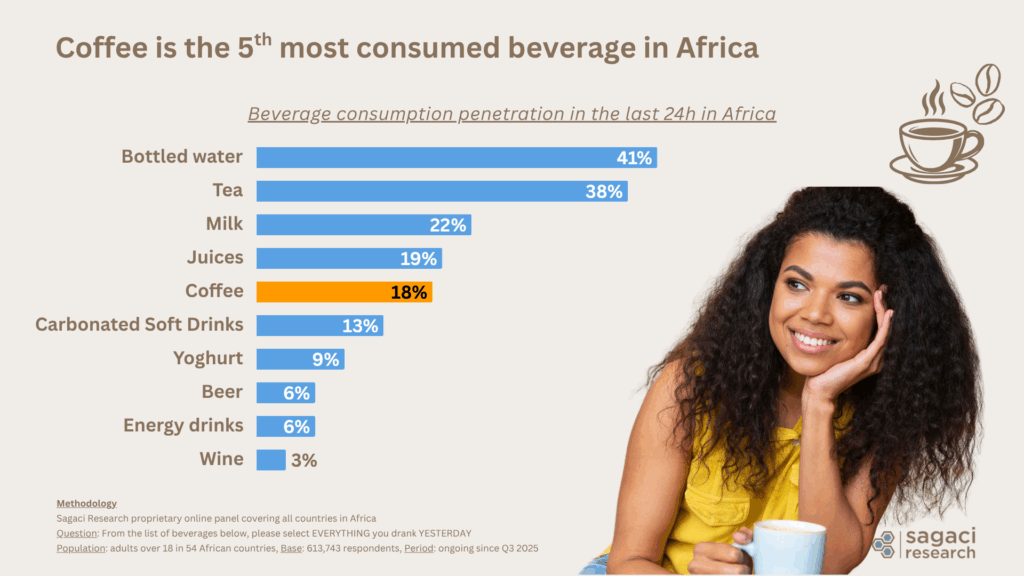
Across all beverages tracked, coffee consumption in Africa reaches 18% daily penetration. It places fifth overall, behind bottled water (41%), tea (38%), milk (22%), and juices (19%), and ahead of carbonated soft drinks (13%), energy drinks (6%), and wine (3%).
That 18% figure means coffee trails tea by 20 percentage points, a gap that carries real strategic implications for brands thinking about share of throat in the beverage segment.
Which African country consumes the most coffee?
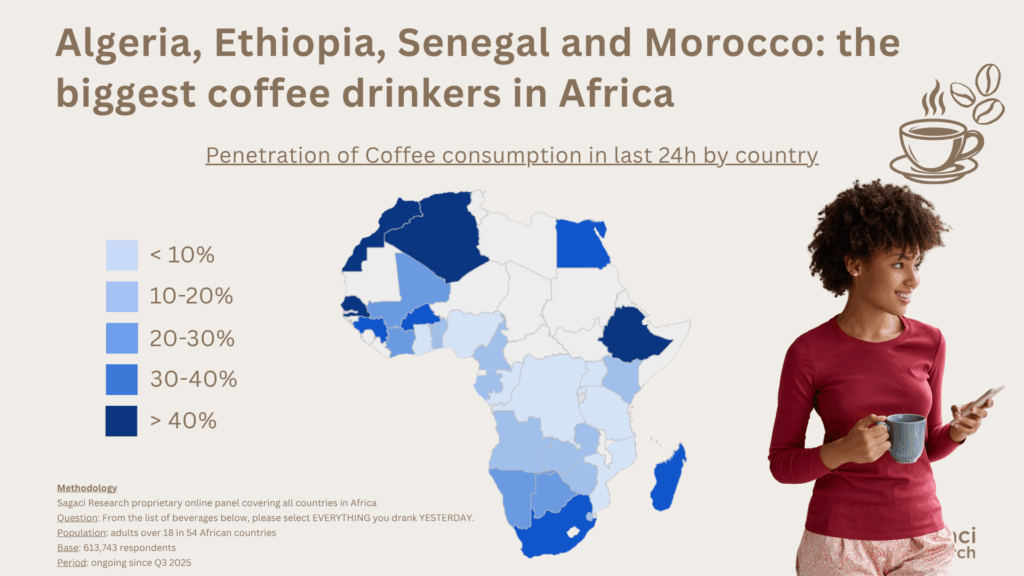
Coffee consumption in Africa is not evenly distributed. The top markets are concentrated in North and West Africa, with Ethiopia, the continent’s largest coffee producer, also ranking among its biggest consumers.
The top 10 countries by coffee consumption penetration in Africa are:
Algeria
- Algeria
- Ethiopia
- Senegal
- Morocco
- Egypt
- Guinea
- Burkina Faso
- Madagascar
- South Africa
- Namibia
The presence of North African markets at the top reflects a deep-rooted café culture in countries like Algeria and Morocco, where coffee is a traditional, deeply social ritual. Markets like South Africa represent a different dynamic: a younger, more westernised specialty coffee scene where consumption habits and format expectations are evolving faster.
Who is the coffee drinker in Africa?
The coffee consumer profile in Africa is shaped by three clear patterns.
Does gender influence coffee consumption in Africa?
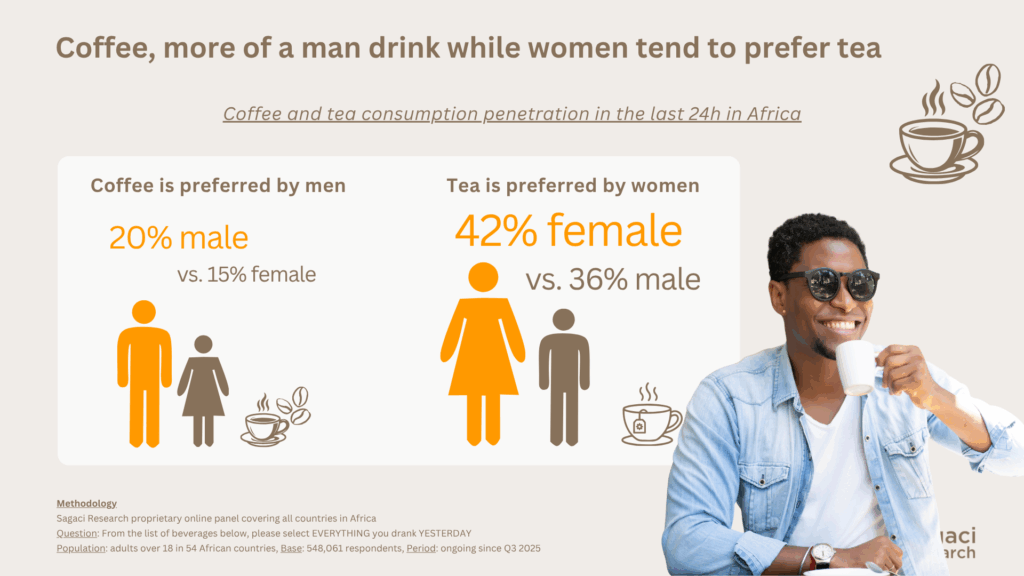
Coffee skews male. Among men, 20% consumed coffee in the past 24 hours, versus 15% of women. The reverse holds for tea, which reaches 42% among women compared to 36% among men. The two categories serve different consumers, and the gender split should inform both positioning and communication.
Which age group drinks the most coffee in Africa?
Penetration rises sharply with age: 15% among 18–25 year olds, climbing to 27% among 46–55 year olds, and 35% among those 55 and above. Coffee has not yet caught on with younger consumers, a structural issue given that Africa’s population skews young.
Does income affect coffee consumption in Africa?
The picture here is less dramatic. The top socio-economic class (A) records 22% penetration, class B reaches 19%, and penetration levels off between 15% and 17% from class C1 downward. Coffee cuts across income levels, which broadens the addressable market for accessible formats.
Coffee consumption occasions in Africa
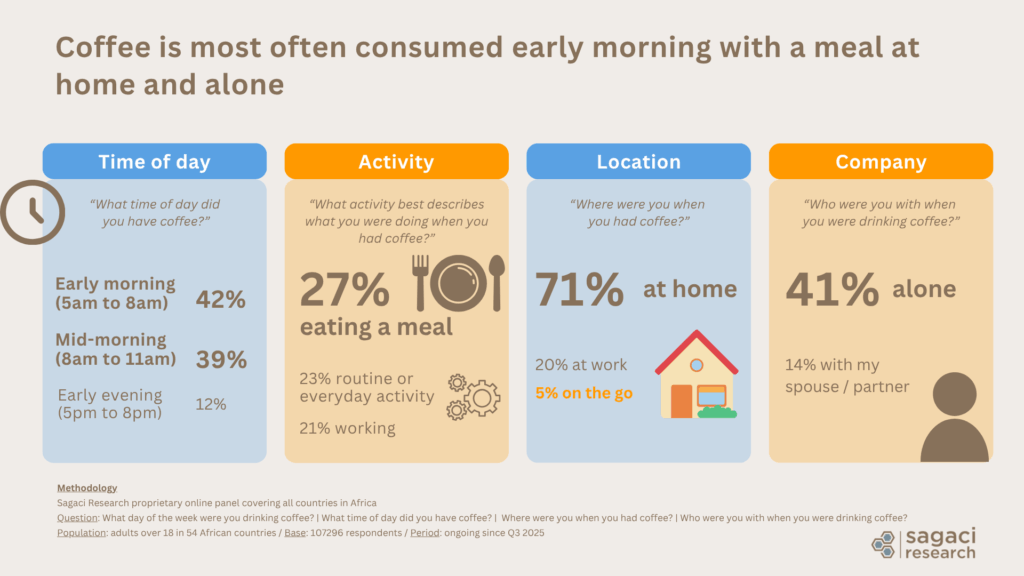
Data on consumption occasions a tell a consistent story: the coffee category is domestic, morning-driven, and tied to routine.
When is coffee consumed in Africa?
42% of coffee consumption in Africa occurs between 5am and 8am, with a further 39% in the mid-morning window of 8am to 11am. Together, the morning accounts for the majority of all consumption. Early evening (5pm to 8pm) accounts for just 12%.
Where do Africans drink coffee?
71% of occasions take place at home, 20% at work, and just 5% on the go. For context, juice consumption in Africa also skews home-based but sees a higher share of on-the-go moments. Energy drinks, a category built around portability, record 15% of occasions on the go, three times more than coffee.
That 5% on-the-go share is worth noting. Coffee’s primary Need State is energy, exactly the kind of functional driver that typically fuels out-of-home impulse consumption. The data raises a question: is the low on-the-go share a reflection of preference, or of limited product availability in that context?
Who do Africans drink coffee with?
41% of occasions happen alone, and just 14% with a spouse or partner. Coffee in Africa is largely a personal ritual, not a social one.
What drives coffee consumption in Africa: the need states
Coffee Need States in Africa are anchored in function, with emotional and physical well-being as meaningful secondary motivations.
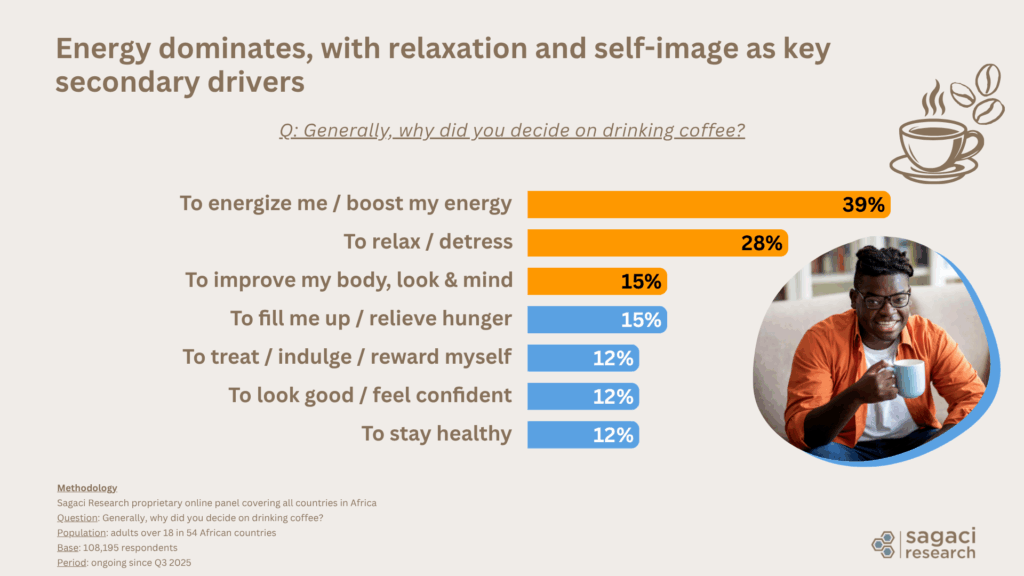
- Driver #1: Energizing (39%) The top motivation by a wide margin. Consumers reach for coffee to get a pick-me-up, stay focused and awake, or simply get going for the day. This is consistent with the morning, at-home occasion structure.
- Driver #2: Relaxation (28%) The second major driver. The same cup carries both stimulation and decompression as motivations, pointing to the richness of the category’s psychological associations.
- Driver #3: Improving body, look, and mind (15%) Tied with filling up/relieving hunger (15%). A meaningful share of consumers associate coffee with broader health and wellness benefits, as well as appetite management. Indulging, looking good, and staying healthy each account for a further 12%.
The coffee Need States picture reveals a category that serves multiple roles simultaneously. Brands communicating to only one motivation are likely leaving part of the market unaddressed.
Beyond the morning cup: where is the growth opportunity?
The data paints a clear picture of what coffee is today in Africa: a domestic, morning ritual consumed mostly at home, alone, and as part of a daily routine. The question for brands is what it could become.
A first clue comes from the shelf. SagaProduct, Sagaci Research’s pan-African shelf intelligence tool, scans products in homes across the continent. It shows that coffee is predominantly sold as soluble: individual sachets of around 2g for single-serve affordability, or larger tin and glass jar formats for household use. Other formats, such as Ready-to-drink SKUs, are rare. The few that do appear are largely Nescafé variants, canned iced coffee formats spotted in markets like South Africa, Uganda, Nigeria, and Kenya.
That said, there are early signals of movement. In South Africa, retailer Checkers recently launched a Nespresso shop-in-shop at its Hyper in Centurion Mall, with a second opening planned in the Western Cape. Capsules and RTD are different formats and different price points, but both point in the same direction: coffee in Africa is beginning to move beyond the sachet and the jar.
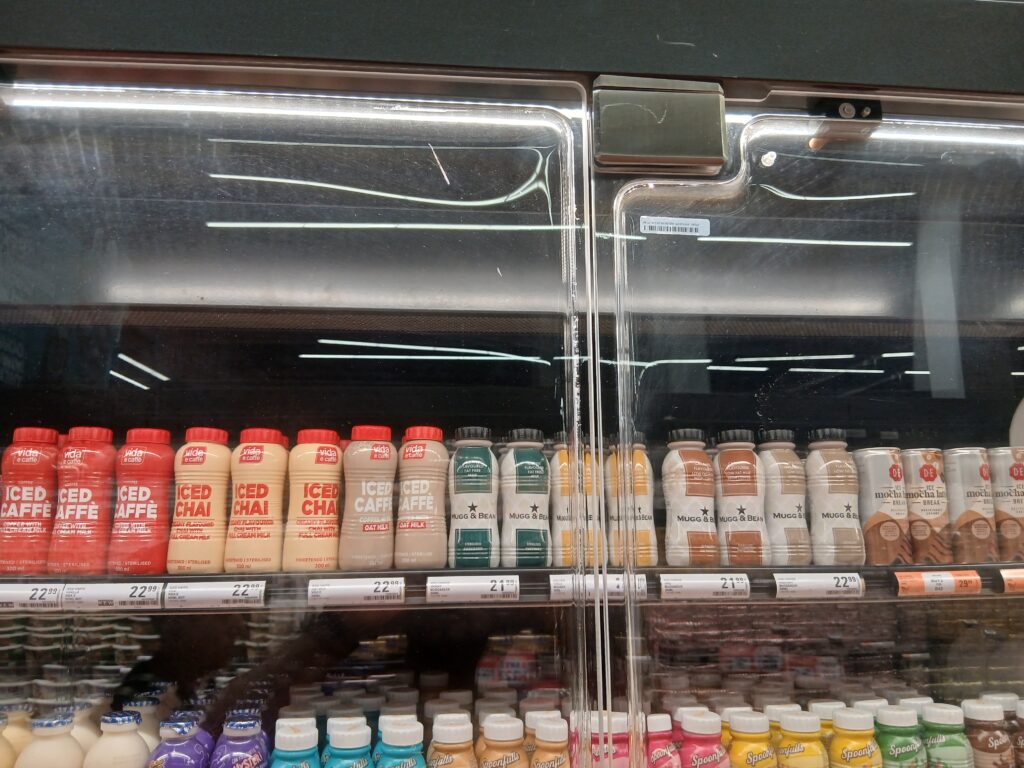
The consumption data points in the same direction. The 5% on-the-go share, against a backdrop of 39% of consumers driven primarily by energy, signals a structural gap between what the category currently delivers and what a portable format could enable. In markets where coffee culture is already evolving, South Africa being the clearest example, a ready-to-drink product removes the home-preparation dependency and meets consumers where their habits are heading.
The demographic picture adds weight. The demographic picture adds weight. The 18–35 cohort underindexes on coffee today, but it will drive African consumer spending for the next two decades. Building the habit now, through more accessible formats, is a long-term category play.
Key takeaways on the coffee category in Africa
Coffee consumption in Africa sits at 18% daily penetration, skewing toward older and male consumers, with a consumption structure centred on the home and the morning routine. Need states are led by energy but extend meaningfully into relaxation and well-being. On-the-go consumption accounts for just 5% of occasions, a figure that, set against the category’s functional positioning, points to real untapped potential.
For beverage brands in Africa, the data suggests two parallel priorities: consolidating the morning ritual among existing consumers, and building the category among younger consumers through formats and occasions that current coffee products do not yet serve.
Want access to the full data on coffee consumption in Africa?
Download the report or contact us at contact@sagaciresearch.com.
Get in touch also for more information on the coffee market in South Africa.
Methodology
SagaCube consumption tracker based on Sagaci Research proprietary online panel covering all countries in Africa.
Questions:
From the list of beverages below, please select EVERYTHING you drank YESTERDAY
What time of day did you have coffee? | Where were you when you had coffee? | Who were you with when you were drinking coffee?
Generally, why did you decide on drinking coffee?
Population: adults over 18 in 54 African countries
Base: 107,296 respondents
Period: ongoing since Q3 2025