

- 26/02/2026
- Posted by: Janick Pettit
- Categories: Articles, Consumer Goods / FMCG, SagaCube

Consumer sentiment in Africa in 2026 reveals a complex picture. While concerns around jobs and the future remain high, optimism has not disappeared.
Based on SagaCube, our consumption tracker across 30 African countries, this latest wave highlights a key reality for FMCG brands in Africa: consumers are navigating economic pressure, yet still projecting themselves forward.
Understanding this balance is essential to anticipating demand shifts across African markets.
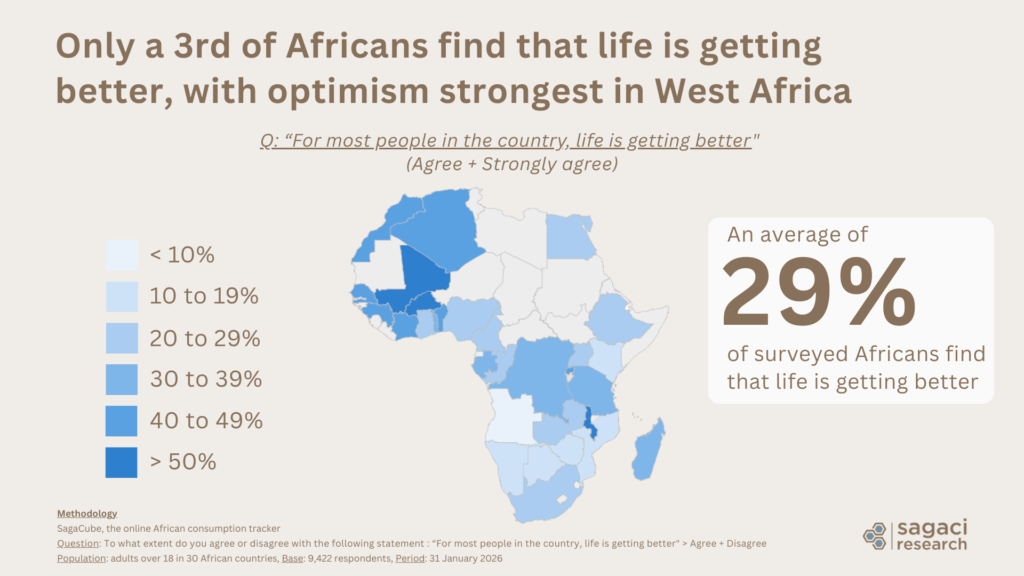
Consumer sentiment in Africa: only 29% see life improving
Despite economic growth narratives across the continent, only 29% of Africans believe that life is improving.
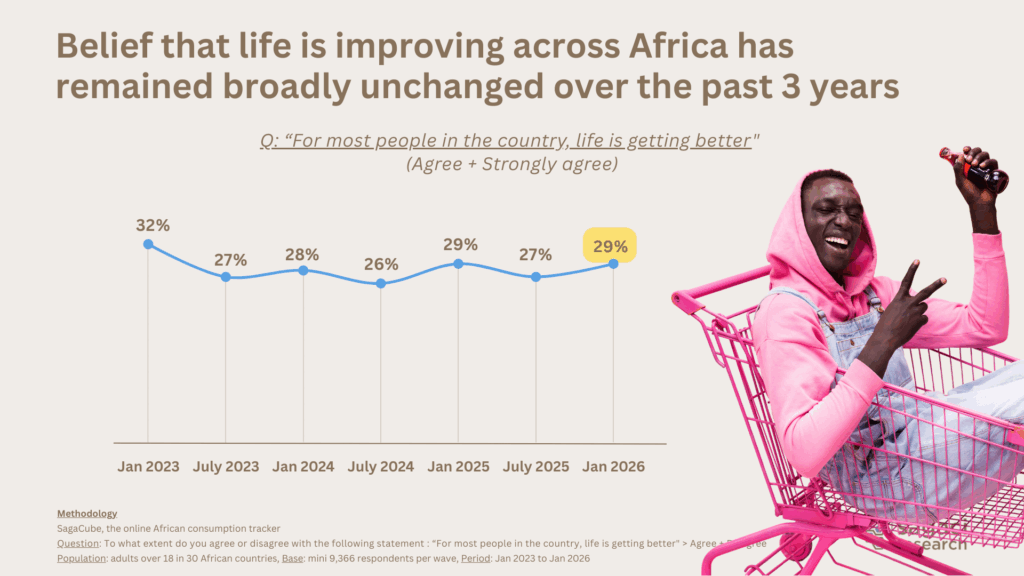
This perception has remained broadly stable over the past three years, suggesting that sentiment is not improving in line with macro indicators.
While inflation is easing in markets like Kenya and Ghana and growth remains strong in countries such as Côte d’Ivoire, these gains are not yet felt at the household level, where purchasing power remains under pressure.
This is particularly visible among the middle class. As explored in our analysis on Africa’s middle class under pressure, more consumers are entering the middle-income segment, but with increasingly constrained disposable income, forcing trade-offs in everyday spending.
This overall picture masks important regional differences, with higher levels of optimism concentrated in West African markets.
Job insecurity in Africa: impact on FMCG consumption and spending
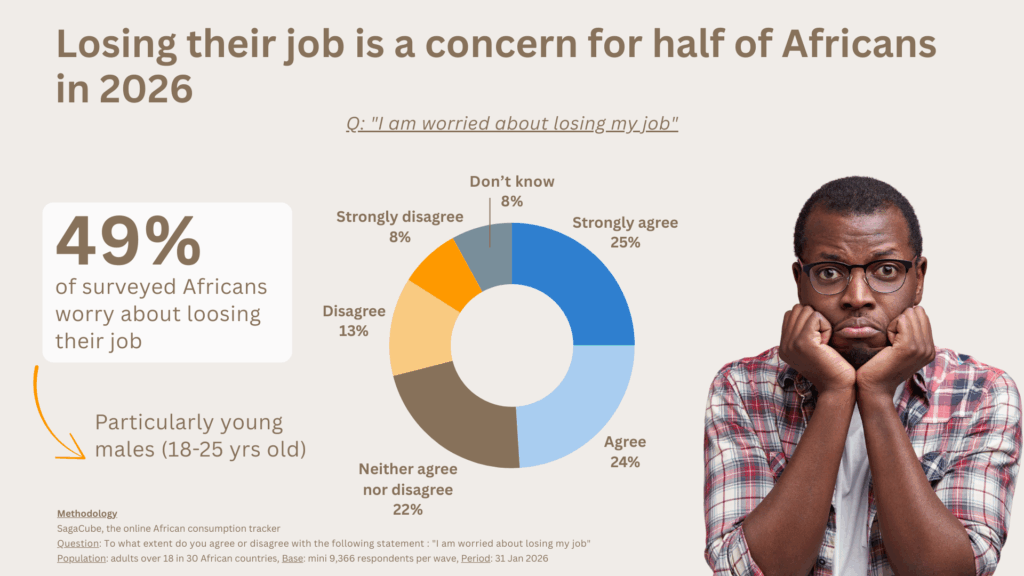
Economic pressure is clearly visible in employment perceptions. Nearly 49% of Africans worry about losing their job, with even greater concern among younger consumers.
At the same time, 67% worry about their children’s future.
These concerns are not abstract. They translate into measurable shifts:
- Downtrading within categories
- Switching to more affordable brands
- Increased reliance on smaller pack sizes
- Stronger responsiveness to price promotions
This reinforces a broader shift: consumers are becoming more selective, not necessarly spending less, but spending more carefully.
This environment is also reinforcing the role of local brands across FMCG categories. As highlighted in our analysis of FMCG brands in Africa, many of the most consumed products are not global names, but local or regional players that better match price expectations and everyday needs. In practice, while global brands often dominate awareness, local brands frequently dominate actual consumption, especially in essential categories.
Consumer outlook in Africa 2026: optimism remains despite economic pressure
Despite these pressures, 47% of Africans feel positive about 2026.
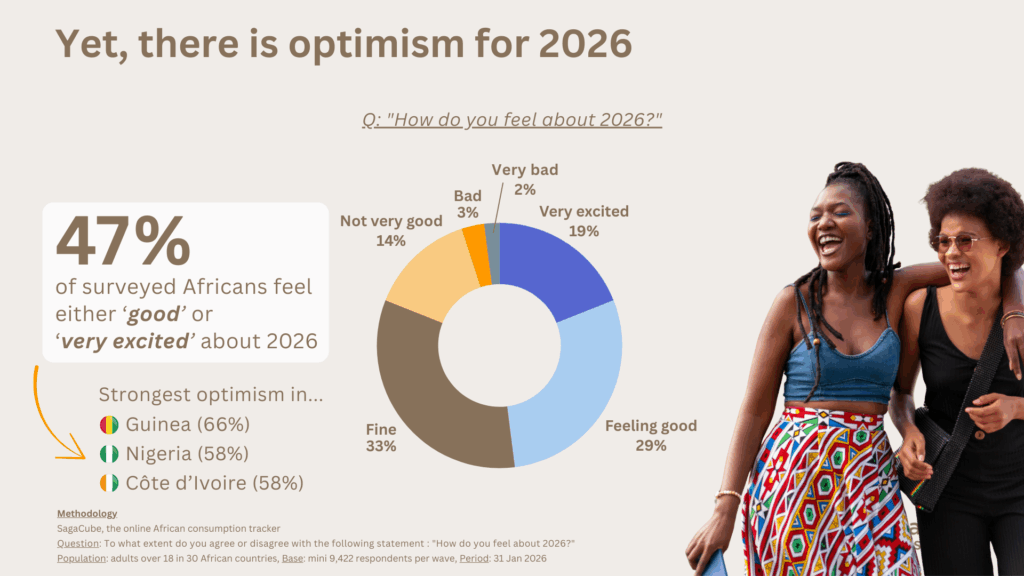
Markets such as Guinea, Nigeria, and Côte d’Ivoire show particularly strong optimism, confirming that sentiment is far from uniform.
For brands, this dual dynamic matters: constrained budgets today, but openness to future improvement and aspiration.
Why consumer sentiment in Africa is both optimistic and cautious
This apparent contradiction reflects structural realities.
A young demographic profile, repeated exposure to economic volatility, and uneven distribution of growth all shape perceptions. Daily constraints remain real, yet expectations for the future, especially for the next generation, continue to sustain optimism.
African consumers are cautious, but not disengaged.
From consumer sentiment to FMCG trends in Africa
SagaCube consumption tracker allows brands to monitor evolving attitudes, financial concerns and outlook across markets.
Linking this to real behaviour is critical. SagaProduct complements this by tracking what consumers actually have at home across categories, pack sizes and brands, capturing real market trends
Together, these solutions help brands:
- Detect early signs of downtrading or premiumisation
- Monitor category resilience under economic pressure
- Identify which brands are gaining or losing ground
- Understand how macro stress translates into household-level behaviour
In volatile environments, linking mindset to market reality is what enables better strategic decisions.
Methodology
SagaCube, the online African consumption tracker based on the largest online panel in Africa, SagaPoll
Questions: To what extent do you agree or disagree with the following statement: “For most people in the country, life is getting better” > Agree + Disagree / “I am worried about losing my job” / “I am worried about my child’s/children’s future” / “How do you feel about 2026?”
Population: adults over 18 in 30 African countries
Base: mini 9,422 respondents per wave
Period: 31 Jan 2026 (+ bi-annual capture from Jan 2023 to Jan 2026 for ‘Life is getting’ question)
© Images by Freepik