

- 09/04/2026
- Posted by: Janick Pettit
- Categories: Articles, Bouillon, SagaProduct
A $44.8 billion deal announced last week is reshaping the global food industry. While much of the attention has focused on Wall Street and European shelf space, the implications for Africa’s seasoning market, and the broader bouillon and condiments category, deserve a closer look.
The McCormick-Unilever deal, explained
The American food company McCormick has agreed to acquire Unilever’s food division. It will bring major food brands such as Knorr, a key seasoning brand in many African markets, and Hellmann’s mayonnaise under one roof, alongside roughly $20 billion in annual revenue.
For Unilever, this is a portfolio reset toward higher-margin categories like beauty and personal care. For McCormick, it is a clear bet: flavour is a long-term global growth engine. The deal is expected to close in 2027, pending regulatory approval.
But its most immediate competitive impact may not be in Europe or the US. It may be in Africa.
Why this merger could change the competitive picture in Africa’s seasoning market
Seasoning is the category at the heart of this deal, and in Africa, it is the one that matters.
In markets like South Africa and Nigeria, two of the largest seasoning markets on the continent, penetration is high. According to Sagaci Research’s SagaCube consumer data, 64% of South African consumers and 78% of Nigerian consumers used seasoning cubes or powder in the last four weeks (2025 survey). Sagaci Research’s pan-African product database SagaProduct shows that in South Africa, Unilever brands lead the bouillon category with Knorrox and Aromat holding strong positions (and carrying that leadership into soups as well, where Knorr and Knorrox also dominate).
In other markets like Nigeria and Kenya, however, local and international competitors often take the lead, with Knorr occupying a more secondary position.
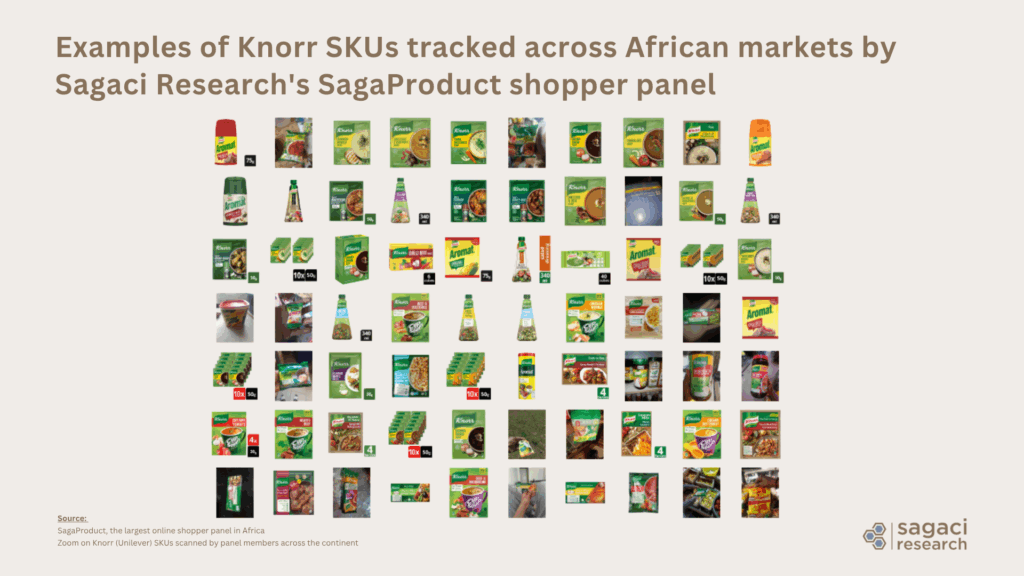
The sheer variety of Knorr SKUs found across African markets reflects years of localised product decisions. The question is whether McCormick, managing a vastly larger global portfolio, will have the appetite to maintain that granularity, or whether standardisation becomes the easier path.
Three implications for African seasoning brands
- Will investment follow scale?
A better-resourced McCormick could accelerate Unilever brands in the markets where they already lead, like South Africa, through increased investment in distribution, marketing, and product innovation. In the markets where they currently sit behind local and international competitors, the question is more fundamental: will McCormick see Africa as an opportunity worth pursuing, or will these markets simply drop down a much longer priority list?
- What happens to local competitors?
If Africa becomes a strategic priority for McCormick, regional seasoning brands and local bouillon producers would face a rival with deeper R&D capability, more capital, and stronger distribution infrastructure. For smaller players, this will raise real questions about how to compete. Some may find opportunity in the disruption that typically follows large mergers: distribution gaps, slower decision-making, moments where a more agile local brand can gain ground. The window may be narrow, but it is real.
- Does consolidation mean less responsiveness to local taste?
This is perhaps the most important question. Unilever seasoning brands’ success in Africa has never been purely about scale. It has been built on product formats, flavour profiles, and price points calibrated to local markets: sachets, plastic shaker-like Aromat, specific seasoning blends, and affordable pack sizes. These are not generic global decisions. They reflect real knowledge of local consumer behaviour. Mega-mergers can centralise decision-making, creating distance between global product strategy and local consumer reality. In Africa, tastes are deeply local: pilau masala and nyama choma in East Africa, pondu in Congo, jollof-style seasoning in Ghana. A seasoning blend that sells in Accra will not necessarily find its market in Nairobi.
Why global food industry consolidation matters for Africa
This deal reflects a broader shift across global food companies toward categories that combine high frequency of use with strong attachment, such as sauces, condiments and seasoning. This is particularly relevant in Africa, where cooking remains overwhelmingly home-based and most meals are prepared from scratch. At the same time, there is a growing need for convenience, with ready-made seasoning mixes, bouillon cubes or pre-blended spices now part of everyday cooking. Even under budget pressure, these products tend to remain part of the basket, with consumers adjusting formats or quantities rather than cutting them out altogether.
For a company like McCormick, this makes Africa’s seasoning market not just a global growth category, but a structurally resilient one.
What happens next for Africa’s seasoning market
The next two to three years will be critical for Africa’s seasoning market. Whether McCormick defines a clear position on Africa early on will matter. So will how competitors respond, through pricing, formats, or distribution.
Most importantly, the companies that understand African consumer behaviour at a granular level will be in a better position to navigate whatever comes next. That means knowing not just what consumers say they prefer, as recent brand tracking data from Ghana’s seasoning market illustrates. It also means knowing what they actually buy: in what formats, at what price points, and how that shifts over time.
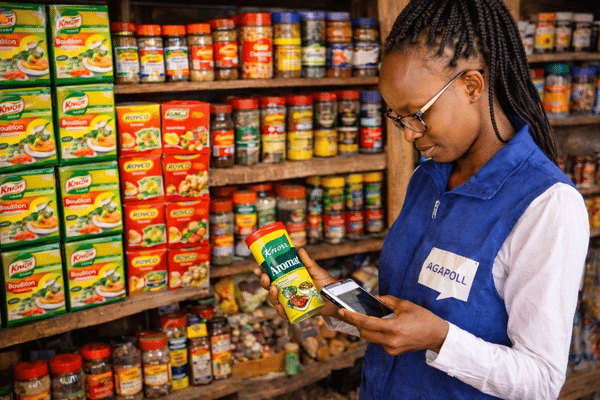
SagaProduct delivers exactly that kind of ground-level category intelligence. SagaProduct tracks product availability, formats and actual purchases across African markets through a pan-African shopper panel. This gives manufacturers, distributors and brand managers an early view of how category dynamics are evolving on the ground, before these shifts appear in topline performance.
In a market that is becoming more competitive and more structured, that level of visibility is no longer a nice-to-have. It is a requirement.
Want to know more about SagaProduct and how it tracks category dynamics across African markets?